
Nose Shape Atlas: 12 Features Seen from the Front and in Profile
The same nose can look quite different from the front and from the side. A frontal view makes the width of the nasal base and the outline of the tip easier to compare. A profile view is more useful for following the curve of the dorsum, the prominence of the bridge, and the direction of the tip.
This atlas separates 12 familiar descriptions into individual sections. Each section contains one matching pair: front view on the left, profile on the right. Read the explanation for that pair before moving to the next.
The number 12 describes this illustration set, not a universal system of 12 mutually exclusive nose types. One nose can combine a prominent bridge, a convex dorsum, and a wide base. These are previously created AI illustrations of appearance, not clinical photographs or models suitable for precise measurement.
First, identify the part you are looking at
- Bridge: Here, the emphasis is on the upper region near the root, between the eyes—whether it projects more or appears relatively low.
- Dorsum: The central contour extending from the root toward the tip—straight, convex, concave, or interrupted by a local hump.
- Tip: Consider both its direction and whether its outline is rounded or tapered.
- Alar region and nasal base: Look at the spread of the lower sides of the nose, rather than confusing it with bridge width.
These landmarks can be compared with the NIH anatomical guide to the nose. The sections below follow the original image order, not a ranking of attractiveness.
01 | Straight dorsum: a relatively straight profile line
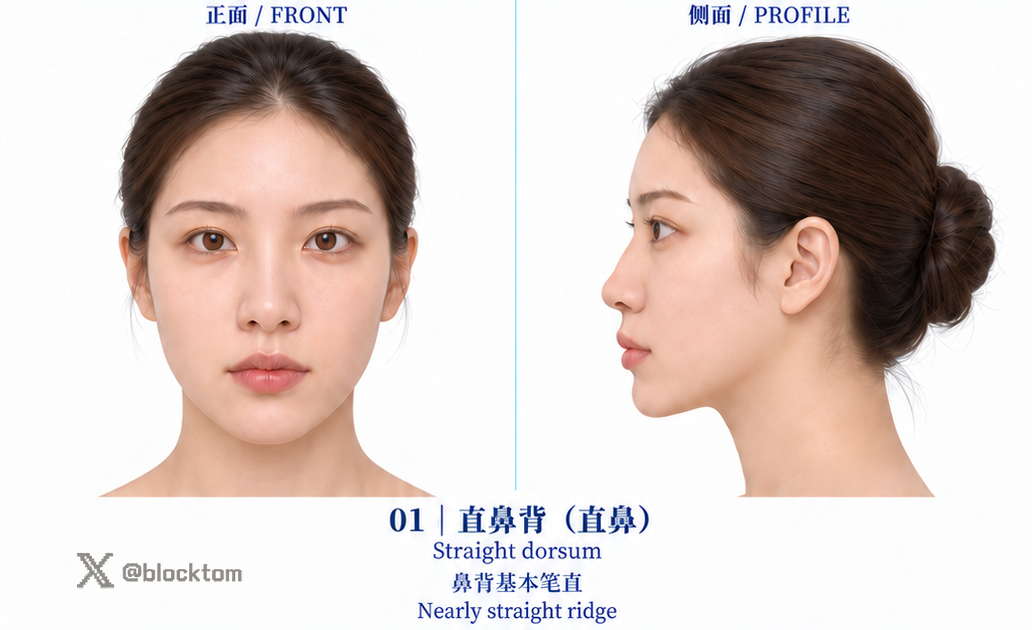
Often called a “straight nose,” this description refers to the line of the dorsum, not a requirement for the whole nose to be tall, narrow, or long.
From the front, you can follow the transition from bridge to tip, but it is difficult to establish how straight the dorsum is from that view alone. In profile, the main contour between root and tip is close to a straight line, without a pronounced outward bow or inward curve.
Do not confuse it with: a prominent bridge. Bridge projection and dorsal curvature are separate features.
02 | Convex dorsum: an outward-curving bridge line
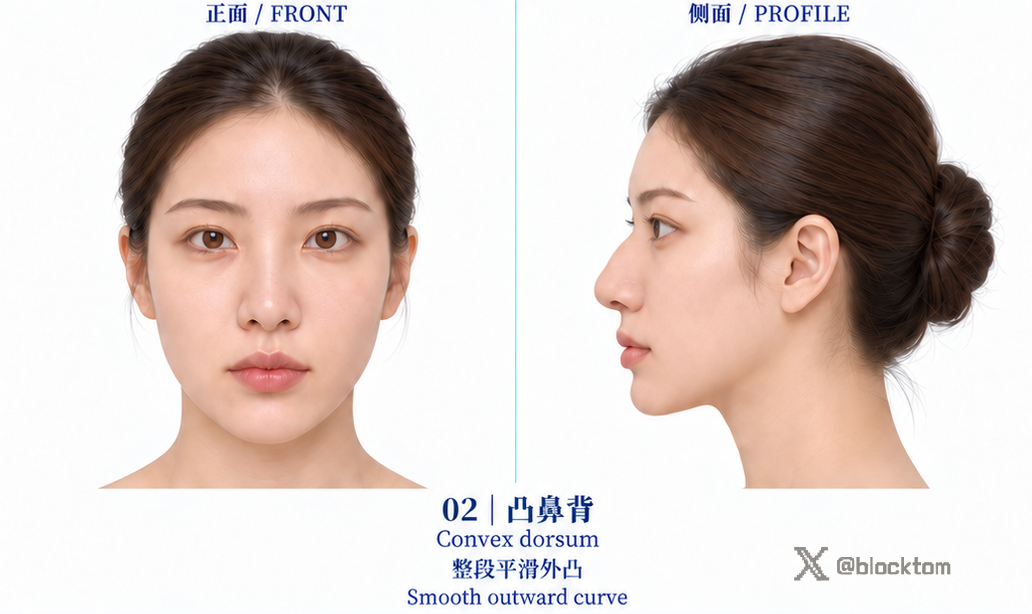
The distinguishing feature is an outward curve along the dorsum. Imagine a line joining the root to the tip: the dorsal contour bows forward of it. This follows the NIH definition of a convex nasal ridge.
From the front, the curve may be subtle; a highlight or shadow alone is not enough to identify it. In profile, look for a continuous, relatively smooth outward arc.
Do not confuse it with: a dorsal hump. Convexity describes the broader curve; a hump describes a more localized elevation. They can occur together.
03 | Dorsal hump: a localized rise along the dorsum
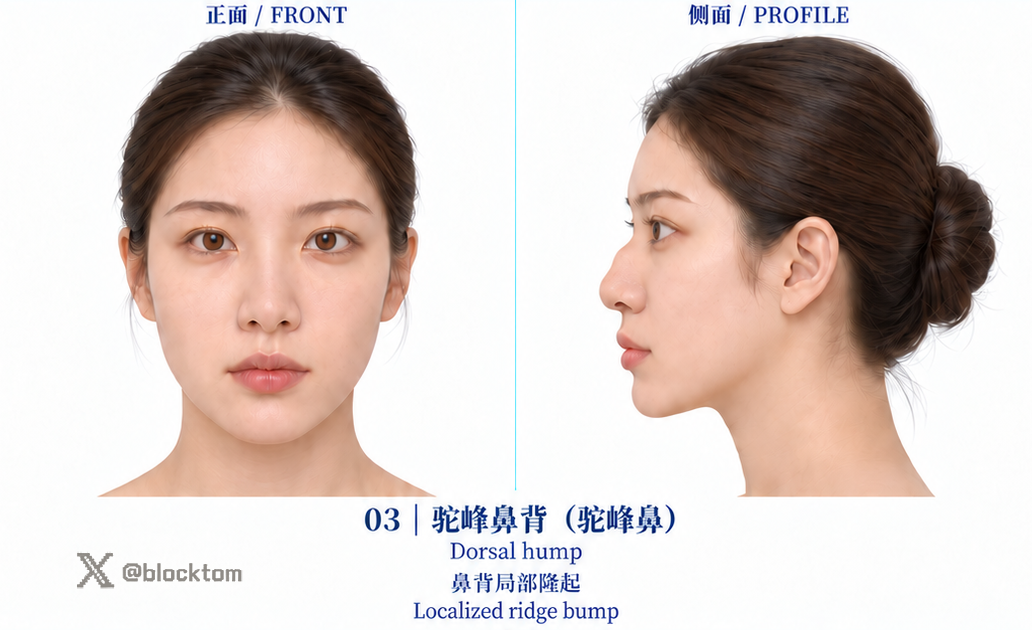
The key is not that the entire dorsum curves, but that one part forms a more concentrated elevation.
From the front, this may appear only as a local contour or lighting change; a shadow is not itself evidence of a hump. In profile, the line rises at a particular point, creating a peak or change in slope. The stretches above and below it can be comparatively straight.
Do not confuse it with: an overall convex dorsum. Ask whether you are seeing a broad arc or a local rise. Comparing this pair with the previous one makes the distinction easier to follow.
04 | Concave dorsum: an inward-curving profile
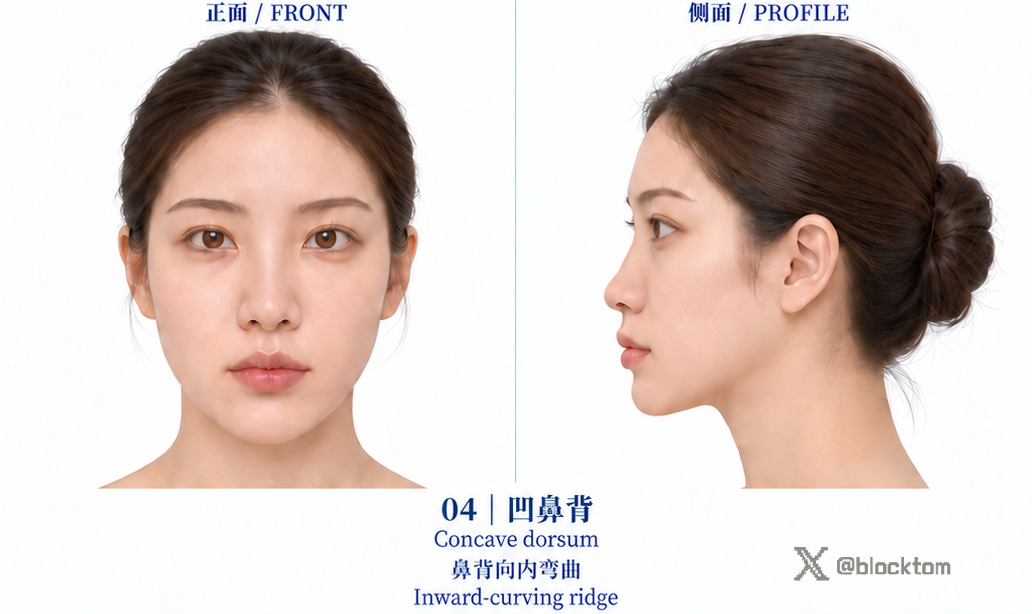
This is the opposite direction of curvature: the middle of the dorsum lies inward of an imagined line joining root and tip. The NIH entry for a concave nasal ridge specifically distinguishes this from a low bridge.
From the front, the full curve is hard to see. In profile, trace the dorsum downward and look for an inward sweep, rather than judging only how far the tip projects.
Do not confuse it with: a low bridge. Concavity describes the shape of a line; bridge height describes the position and projection of the upper region. This illustration cannot establish whether there is structural collapse.
05 | Prominent bridge: more projection in the upper bridge
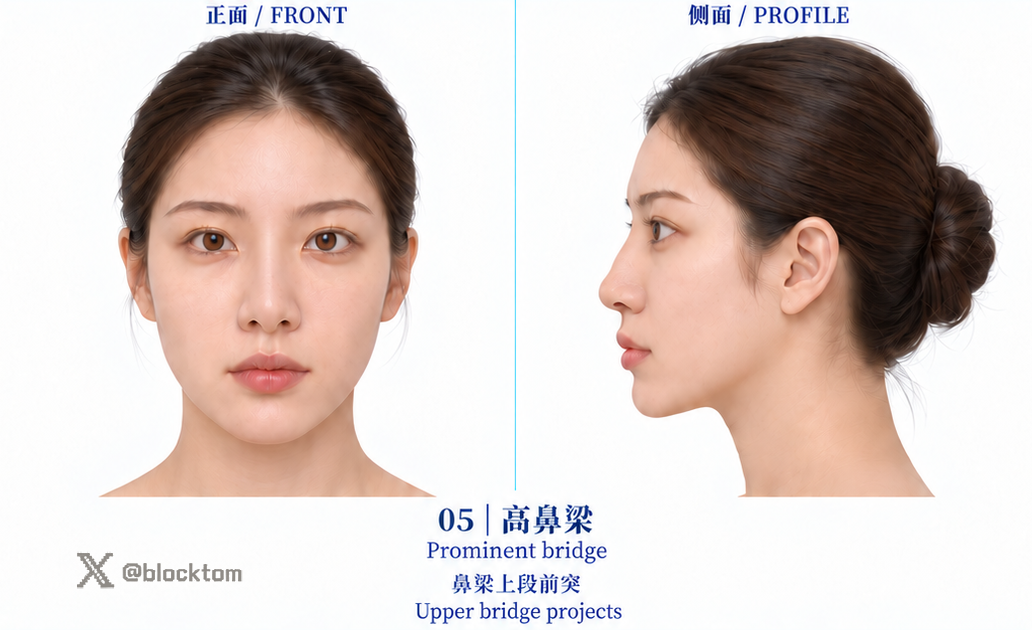
In this set, a “high bridge” means greater forward projection near the nasal root, rather than simply a longer tip. See the NIH entry for a prominent nasal bridge.
From the front, focus on the bridge between the eyes, not the alae. In profile, inspect the transition from forehead to nose and how far the upper bridge stands forward from the face.
Do not confuse it with: narrowness or straightness. A prominent bridge can accompany a straight or convex dorsum, or a relatively wide nasal base.
06 | Low bridge: less projection in the upper bridge
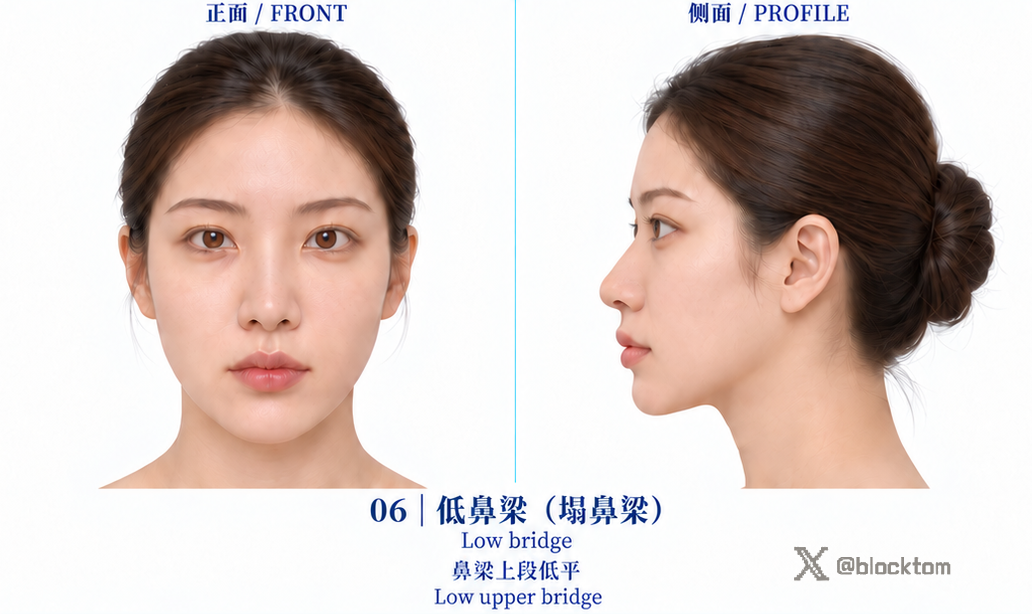
This is the counterpart to the previous feature: the root and upper bridge project less, giving a lower appearance. The familiar Chinese label on the image describes appearance here, not an event in which the nose has collapsed.
From the front, the upper bridge may look less defined, although lighting can influence that impression. In profile, concentrate on the upper bridge rather than comparing tip projection alone.
Do not confuse it with: a small nose or an unprojected tip. Formal assessment also requires context such as age; an illustration is not a universal measuring standard. See the NIH explanation of a depressed nasal bridge.
07 | Upturned tip: the tip turns upward
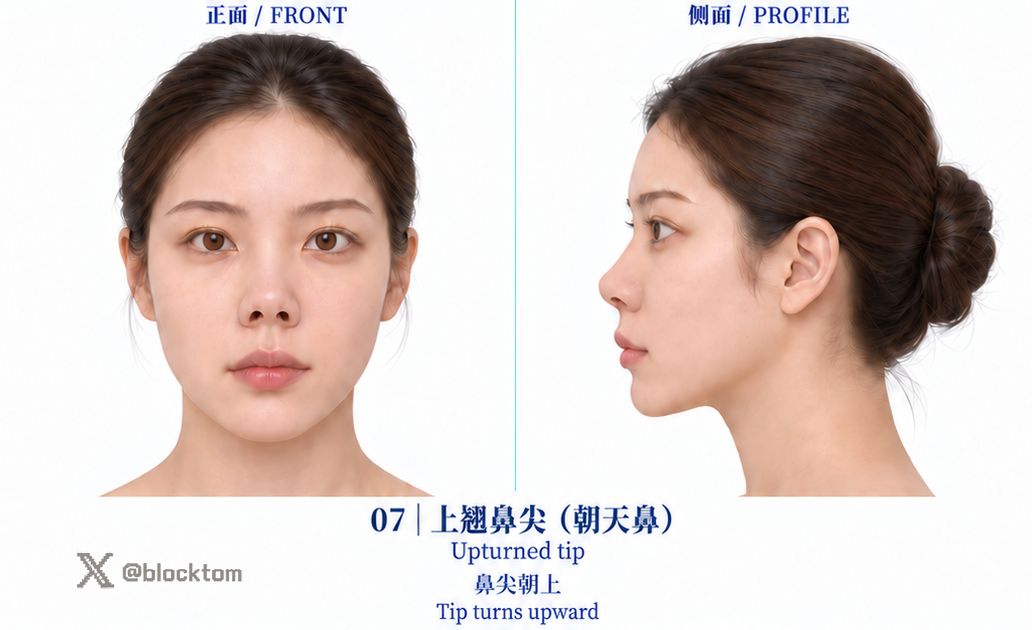
The defining observation is the direction of the tip. The common Chinese expression on the image often refers to an upturned appearance with more visible nostrils from the front.
From the front, the nostrils are easier to see in this pair. In profile, the end of the nose turns upward, creating an upward sweep toward the tip.
Do not confuse it with: a raised head in a photograph. Tilting the head back also exposes the nostrils, so compare similar head positions. “Upturned” describes direction; it does not mean the tip must be pointed.
08 | Overhanging tip: the end of the nose hangs downward
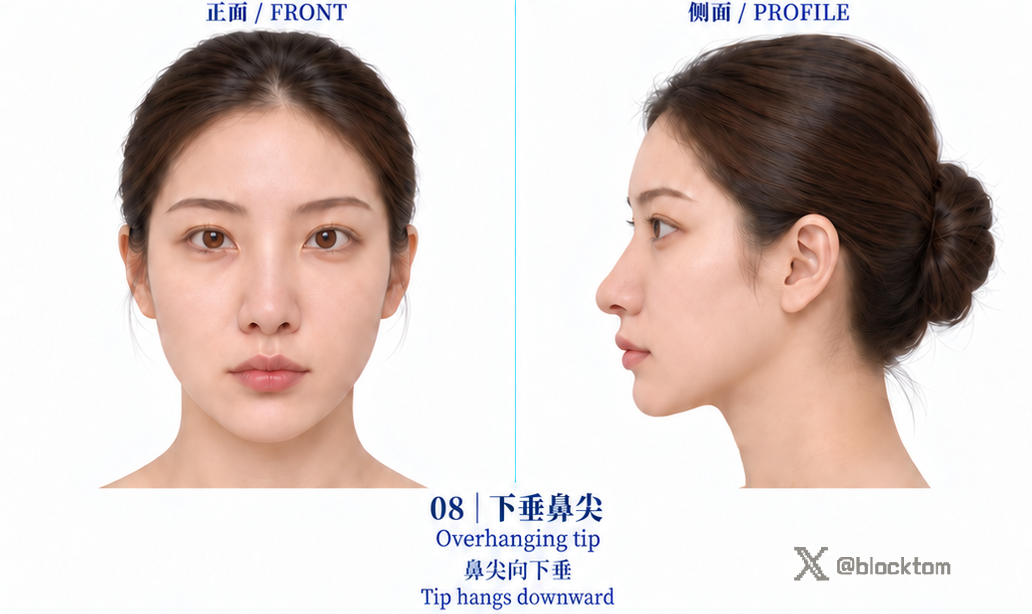
This contrasts with an upturned tip. Look at whether the end of the nose hangs downward, not whether the bridge is prominent. The NIH entry for an overhanging nasal tip describes its position relative to the nasal base and notes that profile is the most informative view.
From the front, the tip may appear to extend downward. In profile, follow the dorsum all the way to its end and inspect the final direction, rather than mistaking a higher dorsal elevation for a drooping tip.
Do not confuse it with: a dorsal hump. A hump concerns the dorsum; overhang concerns the tip. Both can be present, but describe them separately.
09 | Wide nasal base: a broader spread between the alae
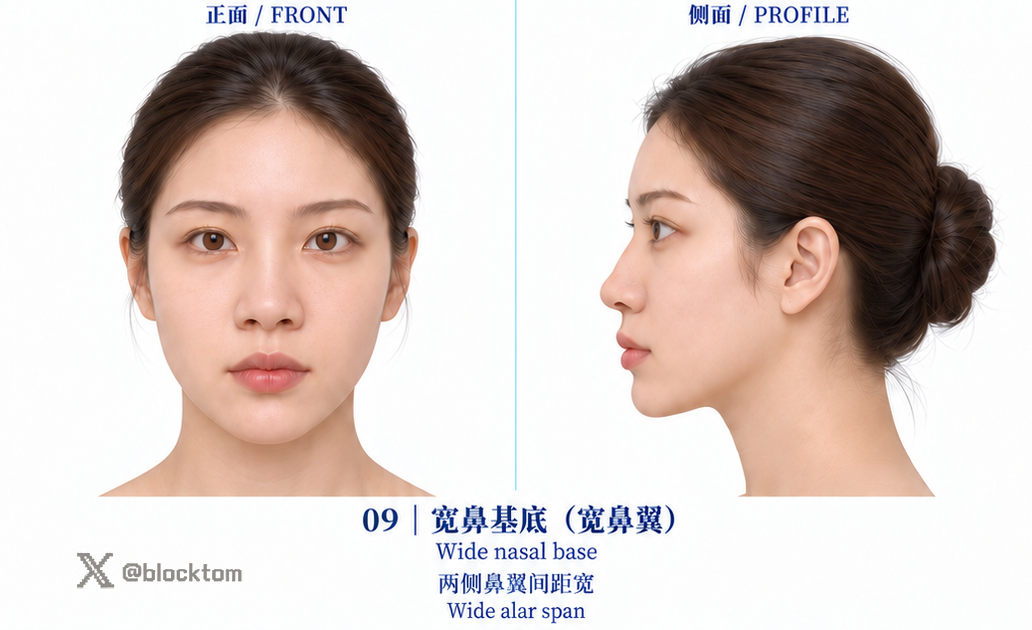
This describes the horizontal spread of the lower nose. In everyday descriptions, “wide nose wings” usually draws attention to how far the alae extend outward.
From the front, compare one outer alar margin with the other and note the lower nose’s width within the face. In profile, the distance between the two sides is difficult to see, so this is not the main view for judging width.
Do not confuse it with: a bulbous tip or a wide bridge. The feature here concerns the lower sides, not just the central volume of the tip.
10 | Narrow nasal base: a smaller spread between the alae
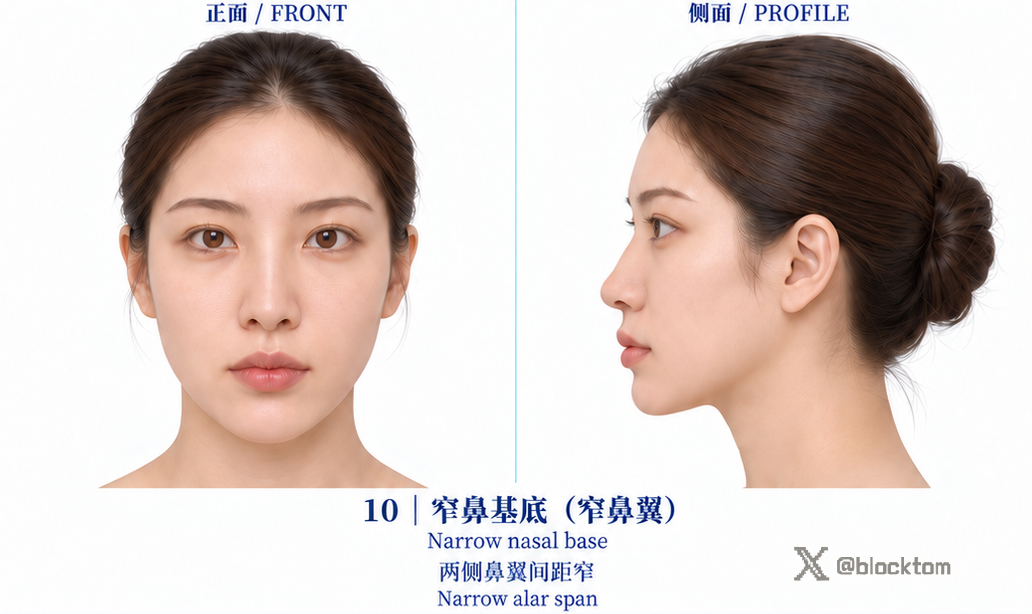
This is the opposite of the previous feature: the lower sides of the nose span a narrower area. Similar facial framing in these illustrations helps keep attention on the alar region.
From the front, the outer margins appear closer together. In profile, the nose may look quite similar to the wider-base example. That is expected: profile does not readily reveal horizontal width.
Do not confuse it with: a pointed tip. A narrow base can accompany a rounded tip, and a pointed tip does not necessarily accompany narrow alae.
11 | Bulbous tip: a fuller, rounded outline
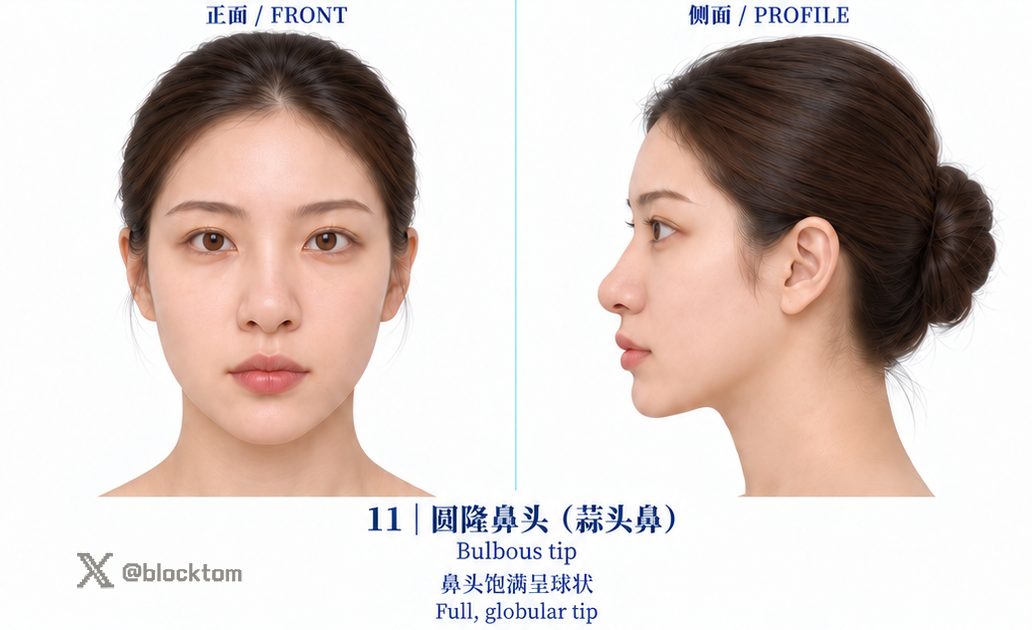
The emphasis is on fullness and a rounded, globular contour. The Chinese nickname on the image literally refers to garlic, but informal labels are not used consistently.
From the front, inspect the central tip for a rounder, fuller shape. In profile, its end reads as a rounded surface rather than narrowing quickly to a point.
Do not confuse it with: width alone. Bulbosity involves both shape and volume, not merely a wide tip or wide alae. The NIH entry for a bulbous nose also notes that the description can involve the lower third of the nose, rather than the tip alone.
12 | Pointed tip: a contour that tapers toward the end
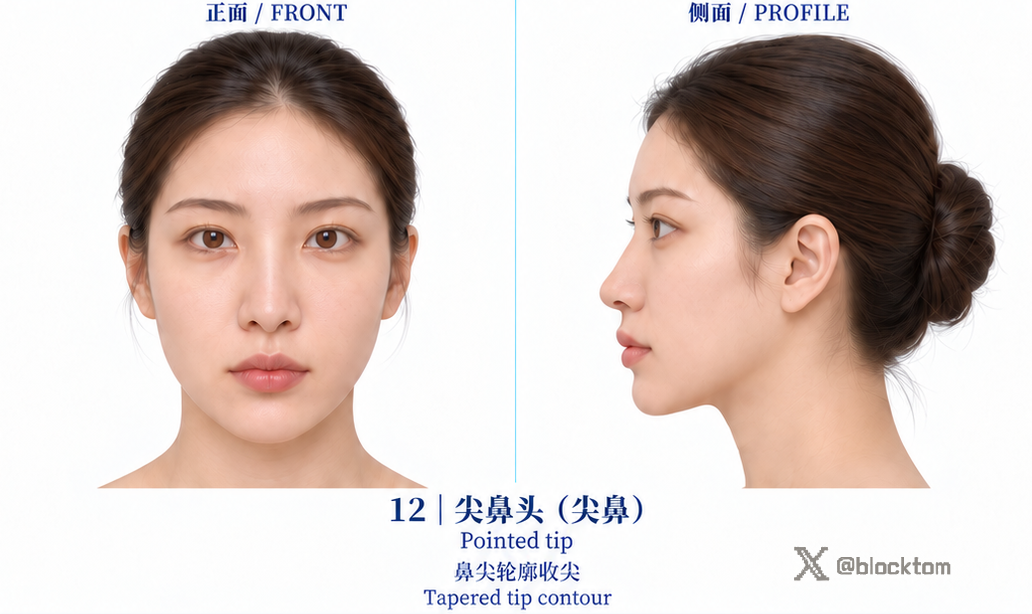
“Pointed” is used here as a straightforward appearance description: the tip narrows toward a more distinct endpoint than the rounded example. This article is not proposing an additional medical diagnosis.
From the front, look at the narrowing of the central tip and the changes in its outline. In profile, the end is more concentrated, contrasting with the rounded ending in the previous pair.
Do not confuse it with: an upturned or overhanging tip. Pointedness concerns shape; those other terms concern direction. A tip can be pointed without turning up, or rounded while turning up.
Combine the features rather than choosing one label
After looking through the 12 pairs, there is no need to choose one exclusive name for your nose. A more useful approach is to ask four questions:
- Is the dorsum relatively straight, broadly convex, concave, or locally humped?
- Does the upper bridge project more, or appear relatively low?
- Which way does the tip point, and is its outline rounder or more tapered?
- From the front, is the spread between the alae wider or narrower?
A low bridge, straight dorsum, and rounded tip are not contradictory. A prominent bridge, dorsal hump, and overhanging tip can also coexist. A nose is better described as a combination of features than by one label expected to explain every detail.
Use similar camera distances, lighting, and head positions when comparing. Identify the region first, trace its contour second, and match the frontal and profile views last. That reveals more than memorizing a nickname.
About the illustrations and terminology
The 12 pairs were cropped individually from the six previously created bilingual Nose Shape Atlas pages. Original frontal/profile illustrations and signatures were retained; the noses were not regenerated or reshaped. AI illustrations help explain appearance, but subtle contours should be read alongside the text and terminology references. The illustrated combinations do not establish attractiveness, personality, or health conclusions.
Terminology was checked against the NIH anatomical guide, the individual entries linked above, and Hennekam and colleagues’ standard terminology for the nose and philtrum. The original 12 display labels are retained without claiming that they form one universal, mutually exclusive medical classification.