
Painter's Paradox: Real Dimensional Advantage Means Changing the Dimension of the Problem
Many people understand “dimensional advantage” as one strong side crushing a weaker side.
But the more interesting version is not about pushing someone lower. It is about suddenly stepping outside the original rules of the game.
A problem that seems impossible inside one dimension may become one simple move in another.
The painter’s paradox is useful because it shows exactly this: sometimes the problem is not insufficient effort, but the wrong dimension.
A mathematical object with finite volume and infinite surface area
There is a famous mathematical shape called Gabriel’s horn, also known as Torricelli’s trumpet.
It looks like an infinitely long horn, narrowing forever as it stretches outward.
Wikipedia defines Gabriel’s horn as the three-dimensional shape formed by rotating the curve y = 1/x, for x >= 1, around the x-axis. Its volume converges to π, while its surface area diverges to infinity.
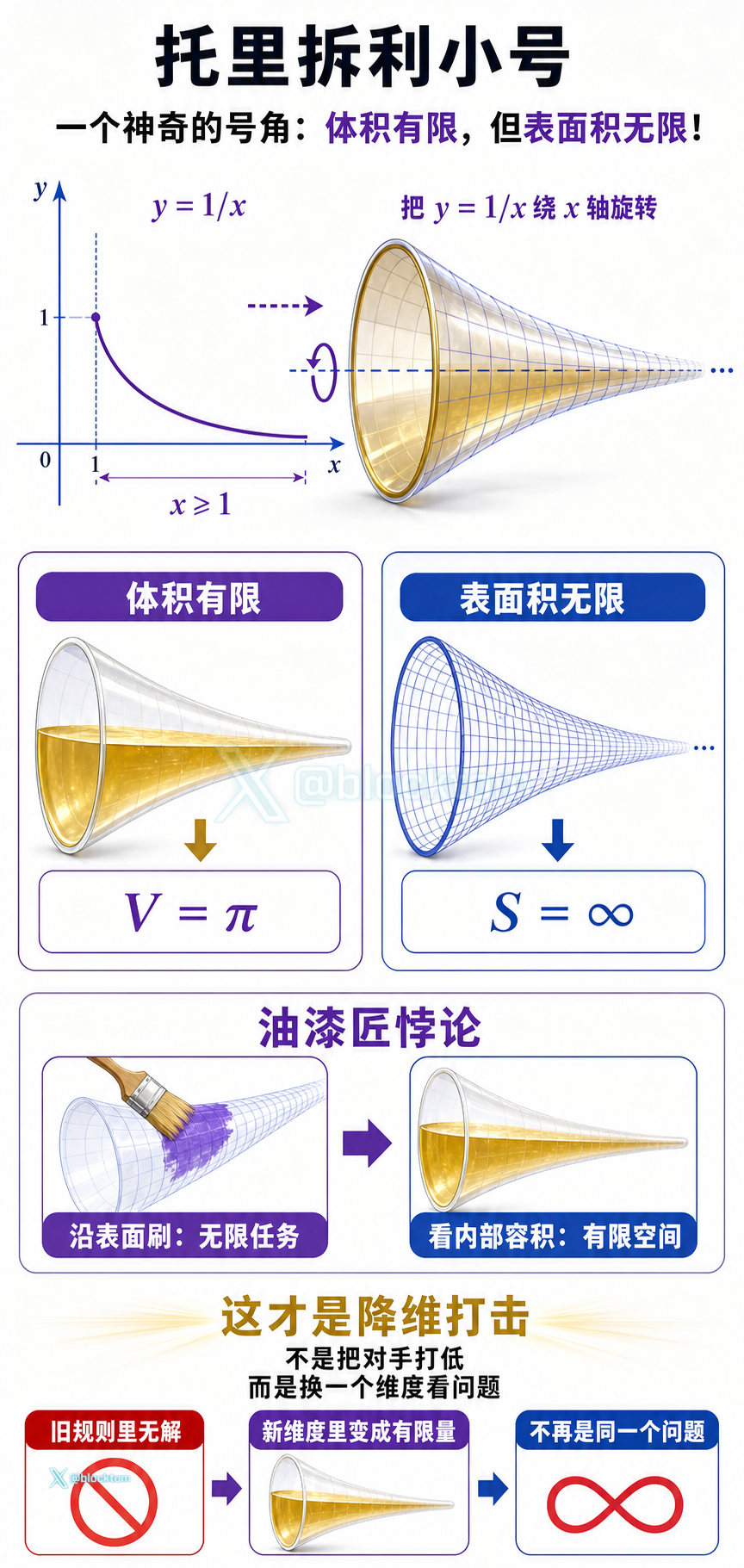
The diagram makes the core contradiction visible first: the outside surface is infinite, while the inside volume is finite.
In other words, this is not merely a very long object. Mathematically, it places finite volume and infinite surface area inside the same shape.
That creates the apparent paradox:
If you are a painter trying to paint its surface, you can never finish.
The surface area is infinite.
But if you change the method and pour paint into it instead of brushing the surface, its volume is only
π, so in the mathematical model a finite amount of paint can fill it.
This is the so-called painter’s paradox.
Of course, in the physical world, this is an idealized mathematical object. Real paint has thickness, molecules, and movement limits. It cannot literally coat an infinite surface in the way the pure model suggests.
But as a thinking model, it is sharp.
Do not prove diligence on an infinite surface
If you insist on “brushing the surface,” you face an infinite task.
You can work harder, move faster, buy a better brush, and train better technique. The problem itself does not disappear.
You are still trapped on the two-dimensional surface.
Once you understand the spatial structure and see that the volume is finite, the method changes.
You do not keep brushing.
You pour.
That is why method can be more frightening than effort.
Effort asks: can I do better inside the original rules?
Method asks: do I need to remain inside the original rules at all?
Low-dimensional effort often means speeding up on the same surface. Higher-dimensional method begins by asking whether that surface is really where the problem lives.
Many people spend their lives painting surfaces
Many people spend their lives painting surfaces.
At work, when asked to repeat low-value labor, they try to become faster.
In relationships, when someone keeps creating emotional exhaustion, they keep explaining, pleasing, and proving themselves.
In business, when the old model becomes thinner and thinner, they keep compressing cost, extending hours, and adding intensity.
In learning, when the method is wrong, they keep using more time to compensate for low efficiency.
All of these resemble the painter.
The problem is not that they are not trying. The problem is that their effort is trapped on an infinite surface.
People who operate at a higher level often do not simply paint more. They first ask:
Must this problem be solved here?
Is there another entrance?
Can the rules be changed?
Can a surface problem become a structural problem?
Can local repair become system redesign?
That is the real meaning of dimensional advantage.
Higher-dimensional thinking is not slogan talk
Dimensional advantage is not about showing off vocabulary. It is not saying “vision,” “systems,” or “first principles” until the words sound impressive.
Real higher-dimensional thinking means finding variables, boundaries, structure, and entry points.
What is a variable?
The thing that actually changes the outcome.
What is a boundary?
What you cannot change, and what you still can.
What is structure?
How the factors influence each other.
What is an entry point?
Where you can act with the lowest cost and the largest effect.
Low-dimensional effort stares at action.
Higher-dimensional thinking looks at structure first.
So the most valuable part of the painter’s paradox is not π, nor even the infinite surface area. It is the reminder behind it:
Do not prove your diligence on a surface that cannot be finished.
Very often, you do not need a better brush.
You need to realize that the problem should not be solved with a brush at all.
Do not turn dimensional thinking into another slogan
Of course, “changing dimensions” is not a universal shortcut.
Not every difficulty can be solved by changing the frame.
Some problems genuinely require fundamentals, accumulation, and patient execution. If a person lacks basic skill but keeps fantasizing about a higher-dimensional move, that is only another form of avoidance.
Real higher-dimensional thinking does not escape low-dimensional fundamentals. It stands on them and sees a larger structure.
When it is time to brush, you still need to know how to brush.
But when you discover that you are facing an infinite surface, you should stop and ask:
Am I using the wrong method to solve a problem that could be approached from another dimension?
That is the real value of the painter’s paradox.
It is not merely a mathematical curiosity.
It is a kind of clarity:
Do not mistake every form of wasted consumption for insufficient effort.
Some games are not won by trying harder.
They are won by changing the game.
Sources
- Wikipedia: Gabriel’s horn